30 Days of Balance #8: Two Levels: Shakespeare vs. The Simpsons

I have a theory that to be truly great a work of art has to hit on at least two levels – that it has to be able to excel with two separate demographics simultaneously. You cannot just draw from one source for too long or the well runs dry. I came to this conclusion while studying Shakespeare during an American Literacy course over a decade ago.

The premise is so: in the 14th and 15th centuries Shakespeare gained great notoriety for the plays performed in London, most notably at the Globe theater. The design of the Globe separated the audience into two distinct parts: the first were the wealthy, sitting in gilded chairs in front of fancy curtains. They filled most of what we would call the balcony and surrounding walls. The second part was the main floor in front of the stage, which more closely resembled a mosh pit than the orderly chair matrix we would find today. This design created a duality with regards to patronage. On any given performance, the gentry would be bumping shoulders with the commoners on their way to and fro, in line for the bathroom, etc. Back then even being within eyesight of a poor person was likely enough for a lady to faint, so you can imagine that such polar groups all shoved in together was quite a feat.

It only worked because of Shakespeare’s art. Most Shakespeare plays were brilliant in the witty repartee of the time, being inventive in their language and ushering in new terminology. They appealed to the educated in their complexity and vanity both. Most Shakespeare plays also featured baudy sexual humour, racy zingers and violent duels and deaths. They appealed to the masses who wanted a little break from the proprietary decrees of the time period. The content of the plays could be performed once and appeal to two entirely unique groups within the city. When the plays came across to America this sensation was made clear tenfold. The Americans treated them more like traveling circus shows than high art. That aspect was lost in translation (from English to English) but the Yanks loved a good dust up as much as the next state. Magic.

I realized this was mirrored in the brilliance of the modern day Shakespeare: The Simpsons (and dear reader please be mindful of the fact we were barely into the double digits with regards to which Simpsons era I was considering). Here we had a show that was clearly the most creative and hilarious thing on TV being made for an audience that mostly appreciated it when Homer fell down or was SMRT. All around the world The Simpsons became a commercial beast with smart alec Bart and dumb Homer as the lynch pins to the physical comedy, and every other aspect of the writing as the genius riding high on another plane. Harvard comedy writers knowing what would keep them on the air and keep them sane at the same time. Magic.

You might not be surprised to learn I really enjoyed MacHomer.

In fantasy I believe a good book tells a great story, but a great book tells multiple great stories to multiple types of audience. When people read Imbalance I want them to find the aspect of the work that best connects to what they seek in an escape. It could be the slower moments of introspection and manifest emotion. It could be the moments thick with desperate battle and unbridled violence. It could be the rings of history encompassing the present. It could be the depth of tragedy. It could be love. It could be the weaving of all five together.

If so, it could grow to be a novel that can hit on two levels.

JM

30 Days of Balance #7: A World Birthed From Maps

In the end, or the beginning, it all began with a map.

As it should. Maps dictate almost every element of world building beyond conveyable possessions. Be it urban proximity or natural divides, once a map is set in stone much of an author’s writing is set in stone, too. The visuals for environments come to life. The distances between locations heighten to essential importance. The need for certainty becomes paramount. The scenery on the map sets out the climate, the abundance of food and water, the flora and fauna, and the hazards of an area until they become hard and fast rules that keep an author honest.

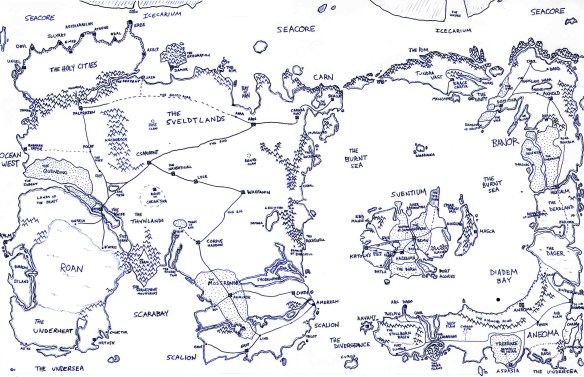
Maps create borders and borders create tension. The vast majority of epic fantasy novels are set during times of war where the political differences of neighbouring nations is critical to the story itself. Borders also create different types of ‘folks’ and therefore serve not only to point out how others live, but to reflect upon how the protagonists live. For example, in Imbalance the wild plains of the Sveldtlands serves as an important divide between the continents of Carn and the Thynlands. It separates an area of the world full of militaristic Barganols and human Taskmasters from the mercantile populations of Csarvent and Loce to the south – and in doing so creates an entirely new group: the Sveldtlander clans. Below is an older version of the world map divided by coloured continent.

One other thing to note before looking at some maps: with Imbalance I set out to do what many of my favourite fantasy series did not – give you the entire map. Wheel of Time leaves off on Shara and Seanchan. The First Law gives you chunks but never the whole thing. Malazan Book of the Fallen shatters a map on the floor and shouts at you to pick up the pieces. Song of Ice and Fire gets close, but ignores much of Essos. In Imbalance it is my aim to provide an entire, more or less precise map. Distances and the charting of landforms may not be satellite accurate, but the cities are the cities and the mountains the mountains. No mysterious ‘Salidors’ to pop up here. If the town is not on the map, then it does not qualify as a town.

Just don’t get mad at me when most all of Purge of Ashes occurs on one continent.

Imbalance Borders Map (33 percent)

An outdated map denoting continental divide.

Imbalance Map

The original hand-drawn map. Plenty of little differences.

P.S.: One day I will do an astrological map to chart the stars and their signs.

JM

30 Days of Balance #6: Value of a Good Ear + Friends

Writing can be very solitary. It can be especially solitary if you’re writing epic fantasy or science fiction wherein the vast majority of plots and terminology are challenging to explain to the general populace. It can be tripley-especially solitary if you’re brand new and none of the people in your life have an inch of respect for your work yet. My work on Imbalance is the same now as it was in the years it took to write and edit, yet thanks to my publishing deal the difference in respect afforded the book is night and day. Once someone in the outside world validates the work it leaps from “yeah, yeah” to “legitimate” overnight. I imagine self-published authors just have to keep pushing forward with this sort of anonymity – at least until a critical mass has read and lauded the release.

Having worked on Imbalance much of my adult life, I came to appreciate three friends of mine in particular who cared enough to listen to my premise and storylines. I’m a talker. These fellows were, principally, listeners. As such, they were well-suited to take it all in, and they already knew me to be a staunch supporter of my own latest projects. The details of the backstory – either told over a few hours of beer, or after badminton, or via questions about my old movie script – bred interest in actually reading Purge of Ashes while most people remained in the dark. These three were my primary beta readers.

I’m writing this post to emphasize the importance of such people – those willing to put faith in you when you have no meter to gauge your faith in yourself. I knew I was proud of the book, that it was very carefully woven, and that it maintained the action-pacing of a feature film. I also knew I read it through rose-tinted glasses and a pervading bravado. To discuss it with others in similar detail as to if we were discussing The Wheel of Time or Malazan Book of the Fallen was integral to realizing it was ready. That I could have a whole conversation with one of these three without mentioning entire story lines – or any character arc in particular – instilled a recognition that there was enough content to merit the page count. Now, friends are friends and not true beta readers – this I know. I think their contributions are just as important but in a different way. Such friends make it worth your while even if every stranger is unimpressed with the book.

They can also confirm that such a scenario is never going to happen.

JM

30 Days of Balance #5: What is Imbalance About?

It is a fine line to preemptively explain an epic fantasy. No doubt it will be filled with fantastical elements, exotic locations, and a bevy of particular terminology. Explaining any major undertaking in such a realm challenging to describe to the layman, and yet – when a book is new – everyone is a layman. I always feel silly when family members, friends, acquaintances or anyone asks what Imbalance is about because I grew up believing a good epic fantasy concerns itself with the growth and development of multiple characters or the deep history of a fictitious world. Paraphrasing a past is just not a palatable prospect.*

I inevitably end up saying something about the following simplified terms:

  • swords

  • monsters

  • magic

  • grit

  • gods

These moments hurt a little because it short changes not just my own story, but every one of the amazing, amazing epic fantasy novels I’m proud to have read and loved. If it is woven complex enough, it simply cannot be readily translated to those with a fringe understanding of the genre. My favourite, Erikson, knows (See this post).

So how does this change now via blog? Well, for one I don’t feel like my audience immediately tunes out after hearing the word “magic.” For two I can choose my words a little more carefully. And for three I can assume some manner of interest beyond due diligence.

My query letter used to end with the line, “Purge of Ashes chronicles the mettle of young soldiers as their impact ripples from a dusty road all the way to the gods’ realm” and this is a pretty good starting point. The series is called Imbalance and it has a short game and a long game. The short game is based around the young soldiers of the Loce Freelancers, third division – who they are before the invasion and who they become while treading the ashes. War and upheaval frequently upset balances of power, leaving the young to fill in the shoes of the dead. They undercut self pity and notions of unfairness with the threat of eradication. Choices made in love and actions taken in hate cause butterfly effects that sway rebellions, quell insurrections or force a return to glory. The ordeal suffered by the Loce Freelancers, third division has repercussions that extend beyond each individual’s inner struggle to create tangible change in the world beyond. To simply tread the ashes is not enough. One must be purged to find solace, and with solace comes the return of balance.

The long game is the second half of the query – about the god’s realm. What constitutes balance between good and evil, chaos and stability, is rooted in the nature of the gods and therefore foreign to the mortal mind. For example, the gods of good and evil (alas, I simplify anyway) have separate notions of what constitutes a fair division of power between them, but it is the mortals who they need to sway. The rest, as they say, is in the text.

One final thing: I could type out a laundry list of concepts I believe to be ‘themes’ in Purge of Ashes and they would read like a Grade 5 class studying abstract nouns. What matters isn’t words like ‘glory,’ ‘redemption’, ‘honour’, ‘bravery’ or ‘love’ – what matters is the weight of all such concepts, and how heavy they feel against your chest. The words are empty and typical without the book behind them – and by the time you have read it in full, you can and will decide for yourself.

*Note: this alliterative sentence is entirely for my epic fantasy comrade Sean Rodden.

30 Days of Balance #4: Progress to Publication I – Original Draft + Movie Script

Imbalance was sat on for a very long time. Numerous times. Creativity for me has always been a sine wave and with each high to productivity comes the balancing low. It is not what it used to be, but with each progression towards the finished book, it is far more a product of what it was than not. All the roots came from a map, but at some point words came into play. There is always a first draft. This post is about the first incarnation of Imbalance and Purge of Ashes, between 2003-2007 when it existed first as a student’s fancy and then as a movie script.

The Original Imbalance Book One: Like most good stories, the characters and scenarios for Imbalance were conceived while steering a dragon boat on Little Lake in Peterborough, Ontario. The shorelines were dotted with houses and the air smelled of the Quaker Oats factory upriver. Being out on the water is quite different from sitting on shore and merely observing. Brushed along by the wind, yet bobbing gently atop the water, it is not so hard to forget oneself and one’s simple chore of turning a 22-passenger boat once every few minutes.

When I got home I collected a series of characters first, having pictured my aforementioned map as the homeland and decided what location suited me best for a beginning. Then I began to write…

I check the word count of my original Imbalance from back in 2003 and I see it totals 44,000 words. It is weird and foreign to me. Everything is out of order. People’s names are slightly different. There are five entire chapters dedicated to what I summed up in about three pages of the upcoming release. Plus I had a point of view from the Scalion Legion, which was… different. I also organized the book in an interesting manner. Four sections of five chapters each, plus prologue and epilogue. Each one was named after a location – the same as the upcoming release but adding ‘Hazenma’ between ‘Katolys’ and ‘The Longest Road’ disparities. Additionally, each chapter had a title, and each title was drawn directly from a war metaphor. For example: Chapters 1-5, from ‘Katolys’, where titled: ‘A Flicker’, ‘Embers’, ‘Heat’, ‘Inferno’, ‘Ashes.’ The chapters for Hazenma reflected the process of a blacksmith forging a sword, and so on. The prologue was called ‘Premonitions’ and featured Ronun Thel’s first memory. The epilogue was called ‘Apparitions’ and was likely a Matthew Good Band reference / cool rhyme.

While I scrapped most of this version when I began to write Purge of Ashes in earnest in 2008, I did borrow some of my favourite bits – and certainly many of the scenes flow similar. The very first scene I ever wrote was Kaern playing with fire in the fire pit beside his farmhouse, which lasted a long time before eventually being turned to memories in the release. The Chapter 1 scene with Bale overlooking the Katolyian wharf was not too different then than it is now. Nor our introduction to Aronan. Where these fledgling scenes were most useful, however, was the year prior when I attended a Television Writing & Producing program where I was asked to pen a movie script.

The Movie Script: Since everyone was there to try their hand at learning how to produce television shows, or in my case create adult animated cartoons, no one was too interested in drawing up a whole movie script for this one particular class. It was the odd combination of ‘movie scripts’ and ‘late night’ and slipped aside the objective of most students – myself included. After imploring the class for at least a few scripts before the winter holidays, I decided that while I had no new ideas for full-length movies, I did have one lingering property…

I took what I had written for Imbalance, chopped the ‘Hazenma’ part right down to almost nothing, and then actually finished the story by filling in the finale in the form of a movie script. I found the time over the holidays because… well that’s the glory of being a student, isn’t it? My teacher praised it some, but then he was desperate to encourage more scripts out of the other students, so I took it with a grain of salt. What mattered most was that I really liked some of the choices I made in the final moments of the script. This script also forced me to keep the dialogue short and to the point, which I believe later helped me with some of my favourite lines in the upcoming release. It also kept the pace of the novel fast and action-oriented, a pacing I am proud of amid my many details.

Now, nothing was ever going to happen with this movie script. Let us clarify that. I had not the comprehension to pursue it, and at the time there was a notable lack of interest in fantasy movies from nobodies. There was a notable lack of interest in fantasy movies from anyone. Anyone not named Tolkien or Rowling, anyway.

So that was where I sat in the new year. Cool script, but who cares? It would take at least a year to realize that the collaboration required to make it in TV was beyond my scope and that writing was a medium I could plumb until kingdom come… but that’s a story for Progress to Publication II.

JM

30 Days of Balance #3: Biting My Nails vs. Writing

Some days my biggest adversary is not getting words into the story, obeying timelines or the organization of the almanac, but the wanton destruction I deliver to my own fingernails. See, finger tips are used to type, and unsightly fingernails can often tarnish said tips. A furious amount of carving disguised as cleaning will ruin these functioning appendages to the point of creating ten hyper-sensitive, throbbing extremities – digits no longer capable of pressing keys without exacting an unfair amount of pain. Equally as nasty, the distraction of having a hand up at my mouth keeps me from typing, lending my mind to long gaps in focus where my subconscious is instead hell bent on straightening some calcium deposit.

It does not bode well for an author. A quick Google search reveals few to no hits correlating the two premises and I find this odd. When I had this problem writing essays in university I used to minimize and load up a hockey video game. It took twenty minutes to play and required both hands firmly on the keyboard. The result was twenty minutes without touching my nails. Biting one’s nails is a strange thing to do – but once you start, it is the sensitivity of the area that drives you back without thinking. Fade that sensation and you are set free.

Alas, this tactic is insufficient. I no longer have twenty minutes to so freely spare.

My solution? I may be one of the only authors to wear a pair of gloves while writing. I am all style in a pair of black gloves so tight they almost cut off my wrist circulation – the kind as ideal for snowballs as they are unsatisfactory at keeping wetness at bay. While this is simply happenstance, it serves the tips of my fingers well because I can still type through the material. Despite their overt benefits, I don’t always choose to wear the gloves, usually resulting in stinging regret. Stubbornness? Discomfort? Assumed control over my vice. Whatever the reason, they are a necessity. They may look a little silly, but if I know I’m in for the long haul I make them my first priority. No one requires their authors to look good during.

As of the writing of this post, the mitts are sitting in a clump beside. I assumed I would have no fingernail problems, but my right index and pinky are sore. I don’t really remember causing the damage. Blog posts are one thing – their style is you and quick to fire off. Imbalance is quite another.

If you’re a writer and have the same problem, I’d love to hear from you.

30 Days of Balance #2: 200,000 Words + One From Joe Abercrombie

Being new is hard.

Being an author is hard, too.

Being a new author with a book breaching 200,000 words is doomed to failure.

Being doomed to failure is hard.

My debut Purge of Ashes clocks in at around 204,000 words, about double what ‘they’ say a newly minted author should attempt. Everywhere I looked my word count was not just implausible or foolish, it was impudent and rude. A sure sign of an upstart university kid who thinks piling words from his engorged lexicon comprises prose fiction. The gall of it, going a book’s length into the sextupal digits. And yet here I am writing with both a publishing deal and the guile to work the word ‘sex’ into a post sans smut. University was a long time ago.

The word count was one of the most daunting aspects of completing Purge of Ashes. Attracting an agent or publisher would be based on their opinion of whether or not I would make money for the company. At first there would be no bearing on quality. The gatekeepers were therefore math types who were hedging their bets to calculate the odds of your book being a success – a risk worth taking. At 204,000 words all the algebra in the world would never fit the right numbers into the right variables for me. The cost of the excess paper required to print the novel outdid my potential, especially if the measure of that potential was 250 words on a single query letter.

I could never simply lop a chunk of the book. The ramifications were either too vast to consider or too damaging to the atmosphere or pacing. Nor could I split the book in two. You don’t set out on a mass exodus only to have the story end mid-jaunt when people’s feet are starting to get sore. One option seemed ideal: print as is and cuff the norms.

The thing is, they say write what you know for a reason. If there was one thing I was comfortable with in my knowledge, besides the TV show Futurama, it was my understanding of why my favourite fantasy series were so great. The Wheel of Time, A Song of Ice and Fire and then later Malazan Book of the Fallen and First Law. None of these were small books. None of them squirmed into the presentation britches of the so-called rules of publishing. If these were what I knew, then an 80,000 page one-off to get my feet wet was not for me. Not grand enough by half.

So what could I do? I had done it my way like a cool dude, but now my way had petered from a paved highway into a lapideous streambed.

An offhand comment from @Grimdark himself, Joe Abercrombie, did the trick. I was beside myself at how impossible maintaining my 204,000 words seemed in a day and age where the internet could tell me ahead of time the many reasons I would fail. No one was going to care to represent my work and my craft was going to be for nothing but a few loyal friends. Then, halfway down the comment section on a thread purporting to tally ‘caps’ for word count by genre, I came upon an old post of Abercrombie’s calling the results into question – and you’re welcome to read it here. (A search for ‘Abercrombie’ will find it for you quickly.) He basically implied that a great number of impressive debuts in the preceding years, including The Blade Itself at 190,000 words, were closer to 200,000 than anything else… so why imply limitations? The successes belied the restrictions.

This prompted in me a steely resolve to ensure Purge of Ashes failed or thrived as conceived. If other excellent books could skip the line then so could I. Even the most famous authors started out timid over their capability. Let April 5th be the judge of the company it will keep.

JM

30 Days of Balance #1: The 30-Day Countdown

In the Imbalance novels, recorded history begins in the span ‘1b’ and winds through time to the present: 340b. Some call the present span 1i instead of 340b because it marks the birth of imbalance, and in accordance they augment their calendars and chronologies. Others cry and cajole that this identifier belongs fifteen years prior in 325b at the live birth. To these purists the world is already in the year 15i. Whether you side with the purists and the live birth or the populists and that endae aft in early Anona when the scales first tipped, the one thing agreed upon is that the days of balance were numbered.

For our purposes, 30 will do.

Today marks the first of a 30-day countdown to the release of Purge of Ashes on April 5th. 30 more days of balance in which to get excited about the trilogy, explain some of the inspiration for the series, discuss the writing process for a debut fantasy novel, and learn some things about me before I get busy finishing the sequel. I have created the majority of these posts ahead of time to ensure the frequency and quality does not wane as the release date approaches and I revert from determined professional to giddy teenager. I hope those interested in reading my debut peruse this list of topics and pick a few they would be interested in to watch out for. A crash course on Imbalance straight from the Arnbred destrier’s mouth.

Happy reading to you all.

JM

Pleasure note that my cover reveal and date for pre-orders are anticipated projections and subject to change.

Saturday, March 5

The 30-Day Countdown

Sunday, March 6

200,000 Words + One From Joe Abercrombie

Monday, March 7

Biting My Nails vs. Writing

Tuesday, March 8

Progress to Publication I: Original Book + Movie Script

Wednesday, March 9

What is Imbalance About?

Thursday, March 10

The Value of a Good Ear + Friends

Friday, March 11

A World Birthed From Maps

Saturday, March 12

Two Levels: Shakespeare vs. The Simpsons

Sunday, March 13

Never Quitting + Warcraft III

Monday, March 14

Favourite Authors

Tuesday, March 15

Progress to Publication II: 6-Year Challenge

Wednesday, March 16

The Cracks of the Day vs. Money

Thursday, March 17

A World Birthed From Documents

Friday, March 18

Love + Art

Saturday, March 19

Writing Women

Sunday, March 20

EARLY SAMPLE: Purge of Ashes

Monday, March 21

Cover Reveal (subject to change)

Tuesday, March 22

Pre-Orders (subject to change)

Wednesday, March 23

Self-promotion vs. The Internet

Thursday, March 24

Naming Conventions

Friday, March 25

Fantasy vs. Horrible Fantasy Covers

Saturday, March 26

Progress to Publication III: The Roddening

Sunday, March 27

Starting in the Storm + Passive Voice

Monday, March 28

Birthday Promotion!

Tuesday, March 29

Short Stories

Wednesday, March 30

The Timeline Doesn’t Matter

Thursday, March 31

Writing vs. Worldbuilding

Friday, April 1

Something Unique + Inspiring

Saturday, April 2

Pronunciations + Pronunciation Keys

Sunday, April 3

Publication + Realmwalker Publishing Group

Monday, April 4

Grip of Dust

Tuesday, April 5

The Birth of Imbalance

Sketches

Sitting here staring at a copy of A Clash of Kings next to the computer. It’s waiting on the table to be transported out to my mother-in-law this weekend who has taken up with A Song of Ice and Fire. I can’t say I would have expected that back in the late ’90s.

Just a quick note tonight that RPG has informed me of incoming sketches from my cover artist – so it has officially begun: the book being made in earnest. I’m am eager to pin down my vision for the cover and very glad RPG is open to artist/author engagement when creating covers. One of my biggest fears throughout the process was spending all these years creating the content only to be afflicted with a cover that featured a half-naked warrior woman next to an old guy in a robe, who is probably a mage but looks like an old guy in a robe, as they grapple with some lizard-man wielding a silver gun akin to the kind you’d find on the cover of a mid-’90s Choose Your Own Adventure cover.

When this cover is done it will be yet another reason to get the hardcover.

JM.

30 Best Fantasy Book Series

This list has been hopping around the internet lately and everyone has been weighing in on its merit: 30 Best Fantasy Book Series

Could be “30 Most Heard Of Fantasy Book Series” just as easily, but perhaps that is exactly what qualifies ‘best’ in this instance: bringing joy to the most people. As works of art, well, such things are in the brain of the beholder.

My main addition to the discussion is to point out the frequency with which people throw out the entire list because of one entry. Either “________ wasn’t on there! VOID!” or “They included ________? Egregious! Detestable! Stupefying!” The greater the amount of variables in a list, the greater the likelihood of something not matching your personal list. That’s why you have a personal list. If you could get your exact point of view from someone else, people would. Yours will always be different. What such lists do is emphasize what the greater population for a given genre or subsection believes to be best, with a few personal favourites thrown in. The closer the content’s source publishers are to Pitchfork the more faith they put in their individual critics, the more power they give their unique take. The broader your platform, the more the publisher seeks to appease. In the former’s case, the list seeks to point out the unheard sometimes at the sake of quality, in the later’s case, the list seeks to emphasize the quality of success at the sake of diversification or unpopular opinion.

So my opinion on the list?

Pretty much every major fantasy series I’ve ever loved is there, no matter how old I was at the time. Can’t go wrong with that. I heard someone complain about a lack of Guy Gavriel Kay on the list, but we’re talking series here, and Kay is known, for the most part, for excellent one-offs. He’s the only exception.

Finally, don’t like a list? Get a voice and make your own.
I once made a qualitative list of my 100 favourite songs. It served its purpose.

JM